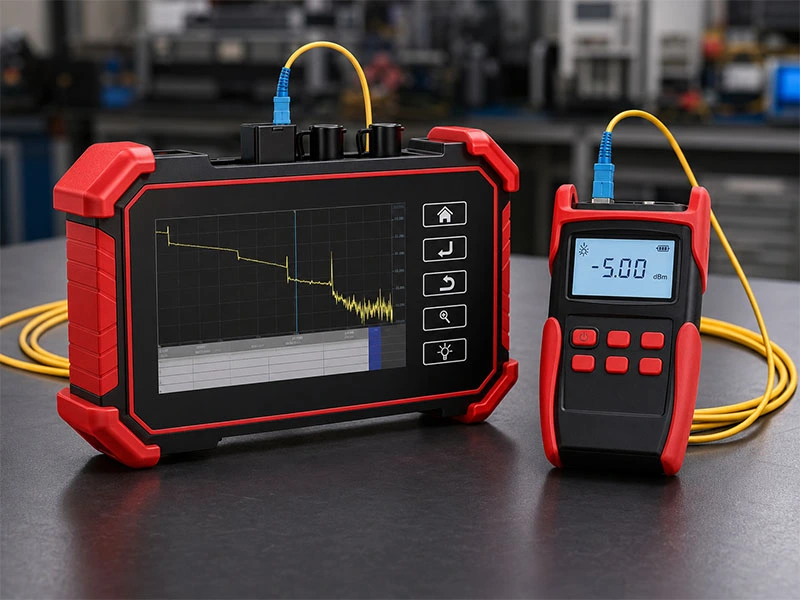
Fiber optic networks depend on accurate testing to keep signal loss low and transmission stable — but two of the most common testing tools measure completely different things. The OTDR (Optical Time-Domain Reflectometer) and the optical power meter are both essential to a fiber testing workflow, yet mixing up what each one actually does is one of the most common mistakes new installers make. Understanding the difference between OTDR and power meter testing determines whether you can locate a fault in minutes or spend hours guessing.
This guide breaks down what each tool measures, when to reach for one over the other, and how they fit together in FTTH, data center, and telecom testing workflows.
What Is an OTDR?
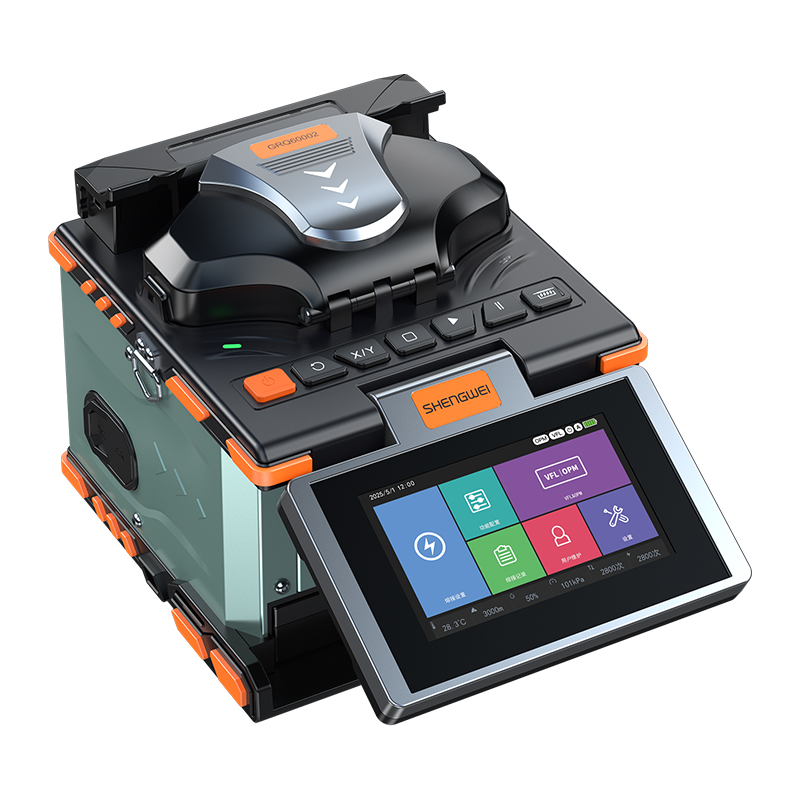
An Optical Time-Domain Reflectometer works by sending a series of light pulses down a fiber and analyzing the light that scatters or reflects back. By measuring the timing and intensity of that return signal, the OTDR builds a full trace of the link — showing every splice, connector, bend, and break as a distinct event, along with its exact distance from the test point.
An OTDR doesn’t just confirm that a fiber has a problem — it shows exactly where. On a 20 km outside-plant route, that’s the difference between troubleshooting the whole cable run and going straight to a fault at the 14.3 km mark.
Main Functions of OTDR Testing
- Locate fiber breaks and faults by distance
- Measure total fiber length
- Analyze loss at each splice and connector
- Identify reflection (return loss) events
- Troubleshoot backbone and outside-plant networks
What Is an Optical Power Meter?
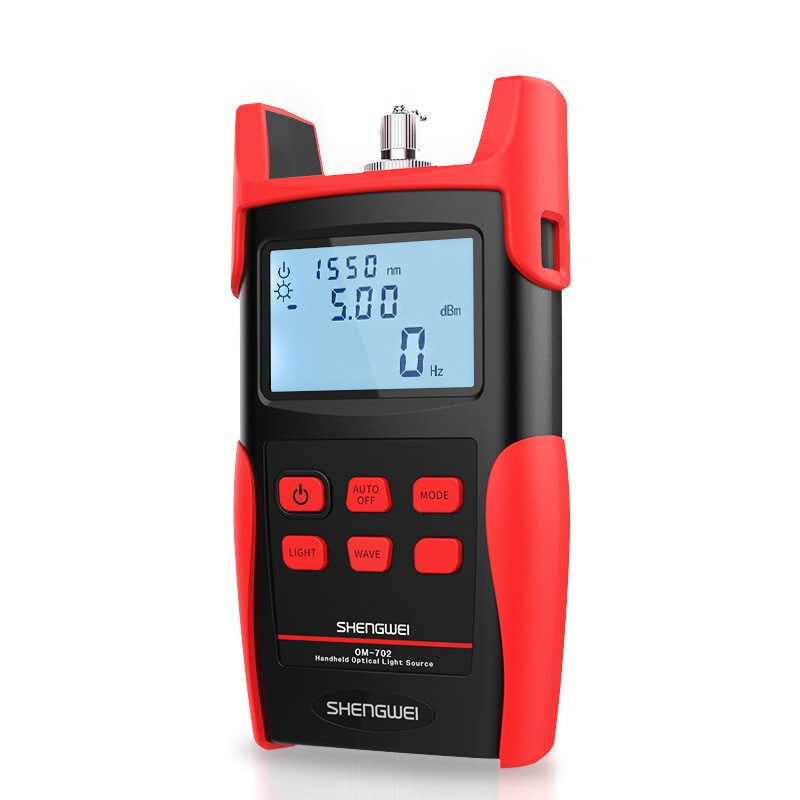
An optical power meter (OPM) measures something more direct: the actual light power arriving at the receive end of a fiber, expressed in dBm. Paired with a stable light source at the far end, it gives a single, immediate reading — is the link passing enough light to work reliably, or not?
A power meter won’t tell you where a problem sits along the fiber. It answers a link-level question: does this connection fall within the loss budget the equipment on both ends needs to communicate?
Main Functions of Power Meter Testing
- Measure absolute optical signal strength (dBm)
- Verify FTTH and GPON connection quality
- Check insertion loss when paired with a light source
- Provide fast pass/fail acceptance testing
OTDR vs Power Meter: Key Differences
| Feature | OTDR | Optical Power Meter |
|---|---|---|
| Main purpose | Fiber analysis and fault location | Optical power measurement |
| Fault location | Precise, distance-based | Cannot locate — power reading only |
| Distance measurement | Yes | No |
| Testing speed | Slower — full trace analysis | Faster — single reading |
| Operation difficulty | Requires training to read traces | Straightforward numeric readout |
| Best application | Backbone troubleshooting, splice audits | FTTH installation, patch cord verification |
Which Tool Should You Choose?
FTTH Installation
An optical power meter is usually enough for daily FTTH work, since technicians mainly need fast verification of GPON signal level, ONU optical connection, and overall drop-cable link quality. OTDR testing is typically reserved for the feeder and distribution segments, where locating a fault across several kilometers of cable matters more than a quick reading.
Telecom & Backbone Networks
OTDR is the preferred tool for long-haul fiber routes, underground cable networks, and complex fault diagnosis, where full-trace documentation and precise event location are required.
Fiber Maintenance Workflow
- Confirm there’s a signal problem using a power meter.
- Locate the exact fault with an OTDR.
- Repair the splice or connector.
- Verify the final optical power with the power meter.
Can an OTDR Replace an Optical Power Meter?
No — they measure different aspects of fiber performance, and most testing workflows need both:
- OTDR: Distance, fiber events, reflection, and loss distribution along the entire link.
- Optical power meter: Actual received optical power and link-level signal verification.
A Third Tool Worth Knowing: The Visual Fault Locator (VFL)
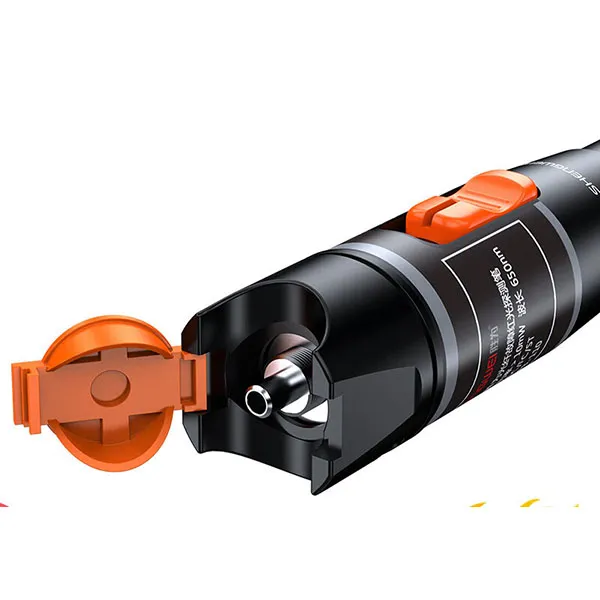
Between the OTDR and the power meter sits a simpler, faster tool many installers reach for first — the Visual Fault Locator (VFL). A VFL sends a visible red laser down the fiber; at a break, sharp bend, or bad connector, the light leaks out and becomes visible through the jacket or at the connector face.
A VFL can’t give a distance reading or a power measurement, but for quick continuity checks, confirming fiber polarity, or spotting an obvious break before pulling out heavier test equipment, it’s often the fastest first step — and a tool every field technician’s kit should include alongside a power meter and OTDR.
Common Fiber Testing Tools at a Glance
| Tool | Application |
|---|---|
| Optical Power Meter | Check optical signal level and link certification |
| OTDR | Locate fiber faults and analyze splice loss |
| Visual Fault Locator (VFL) | Identify visible fiber breaks and bad connectors |
| Fiber Inspection Microscope | Check connector end-face condition and cleanliness |
Frequently Asked Questions
Is OTDR better than a power meter?
Neither tool is “better” — they serve different purposes. An OTDR is built for troubleshooting and fault analysis across a full fiber link, while a power meter is built for fast, single-point signal verification.
Do I need an OTDR for FTTH installation?
For most FTTH installation work, an optical power meter is enough to verify each connection. An OTDR becomes useful when troubleshooting a problem link or auditing a larger feeder/distribution deployment.
Can a power meter find fiber breaks?
A power meter can tell you that signal loss is too high, but it can’t pinpoint where the break is. An OTDR — or a VFL for shorter distances — is needed to locate the fault precisely.
What’s a normal power reading for an FTTH connection?
This depends on the specific ONT/OLT equipment, but most GPON systems expect receive power within a manufacturer-specified range, commonly between -8 dBm and -27 dBm at the ONT. Always check the equipment datasheet rather than a general figure.
Is a VFL a substitute for an OTDR?
Only for short-range checks. A VFL is effective up to roughly 5–10 km on typical FTTH and patch cord fiber, and it can’t measure loss precisely. Long-haul fault location still requires an OTDR.
Conclusion
OTDR and optical power meters are both essential fiber optic testing tools, but they solve different problems. An OTDR provides detailed, distance-based analysis for troubleshooting complex fiber networks, while a power meter delivers quick, reliable verification during installation and daily maintenance. A Visual Fault Locator fills the gap between the two, catching obvious breaks before heavier equipment comes out.