As network infrastructure continues to expand, many enterprises, ISPs, security projects, and industrial systems need to connect copper Ethernet devices with long-distance fiber optic links. Traditional Ethernet cables are easy to deploy, but they are limited by transmission distance and are more vulnerable to electromagnetic interference in complex environments.
Fiber media converters provide a practical way to solve this problem. They allow existing Ethernet devices with RJ45 ports to communicate over fiber optic cables without replacing the entire network system. This makes them a cost-effective solution for network extension, building-to-building connectivity, surveillance systems, industrial communication, and FTTx access networks.
For many network projects, fiber media converters are not just simple conversion devices. They are important tools for improving transmission distance, deployment flexibility, and network reliability.
What Is a Fiber Media Converter?
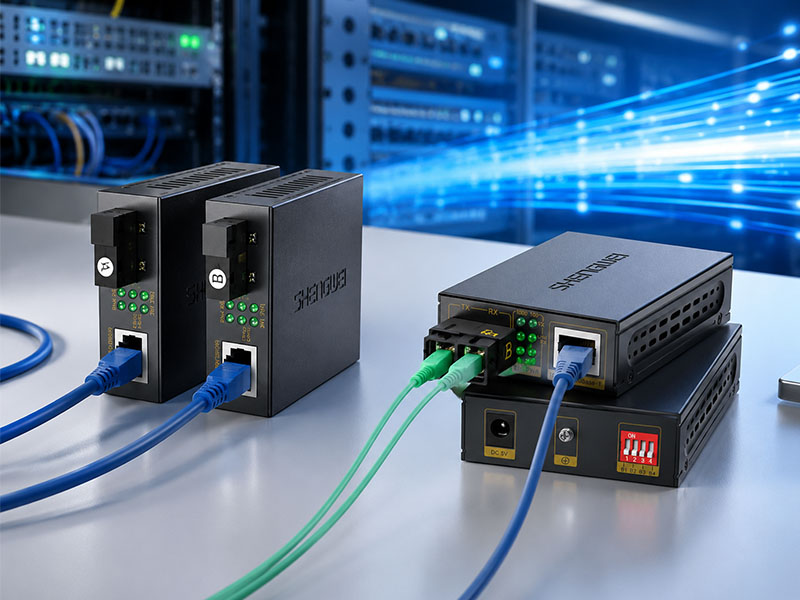
A fiber media converter is a network device that converts electrical Ethernet signals into optical signals, and also converts optical signals back into electrical Ethernet signals. In a typical network connection, one side of the media converter connects to copper Ethernet equipment through an RJ45 port, while the other side connects to a fiber optic cable through a fixed optical port or an SFP module.
This allows copper-based Ethernet devices, such as switches, routers, IP cameras, computers, access control systems, and industrial controllers, to communicate through fiber optic infrastructure.
A common network connection looks like this:
Ethernet switch → Fiber media converter → Fiber optic cable → Fiber media converter → Ethernet device
By using this structure, network installers can extend Ethernet transmission far beyond the normal copper cable distance limit and build stable long-distance connections.
How Do Fiber Media Converters Work?
The working principle of a fiber media converter is straightforward. When an Ethernet device sends data through a copper cable, the media converter receives the electrical signal from the RJ45 port. It then converts that electrical signal into an optical signal and sends it through the fiber optic cable.
At the other end of the fiber link, another media converter receives the optical signal and converts it back into an electrical Ethernet signal. The connected Ethernet device can then receive the data normally.
This conversion process allows different transmission media to work together in one network. Copper cables are useful for short-distance device connections, while fiber optic cables are better for long-distance, high-stability, and anti-interference transmission.
In many projects, fiber media converters make it possible to upgrade part of the network to fiber while continuing to use existing Ethernet devices.
Why Fiber Media Converters Are Used in Modern Networks
Fiber media converters remain widely used because many network environments still include copper Ethernet equipment. Replacing every switch, camera, router, or terminal device with fiber-enabled equipment can be expensive and unnecessary. A media converter offers a simpler way to connect these devices to fiber optic networks.
Extend Ethernet Transmission Distance
Standard copper Ethernet cables usually support limited transmission distance. Fiber optic cables can support much longer distances depending on fiber type, optical module, wavelength, and power budget. Fiber media converters help extend Ethernet networks from short-distance copper links to long-distance fiber links.
This is especially useful for connecting different buildings, outdoor security points, industrial sites, campus networks, and remote network terminals.
Connect Copper Networks with Fiber Infrastructure
Many existing devices only have RJ45 Ethernet ports. Fiber media converters bridge the gap between copper Ethernet equipment and fiber optic cabling systems.
This is useful in projects where the backbone network uses fiber, but the terminal devices still use standard Ethernet interfaces.
Improve Anti-Interference Performance
Fiber optic transmission is less affected by electromagnetic interference compared with copper cables. In factories, power systems, transportation networks, elevators, and outdoor cabinets, fiber links can provide more stable communication than long copper cable runs.
Reduce Network Upgrade Cost
Instead of replacing all existing Ethernet devices, installers can add fiber media converters at both ends of the link. This lowers upgrade cost and reduces installation complexity.
For many small and medium network projects, this is one of the biggest advantages of fiber media converters.
Support Flexible Deployment
Fiber media converters are available in different forms, including desktop models, rack-mounted chassis models, SFP-based models, and industrial DIN-rail models. This flexibility allows them to be used in many different network environments.
Main Types of Fiber Media Converters
Different network projects require different converter types. Understanding the main categories helps users match the right product to the right application.
Fast Ethernet Media Converter
Fast Ethernet media converters usually support 10/100Mbps Ethernet connections. They are suitable for basic network access, low-bandwidth monitoring systems, legacy Ethernet devices, and simple point-to-point connections.
Although Gigabit networks are more common today, Fast Ethernet converters are still used in some cost-sensitive or legacy systems.
Gigabit Fiber Media Converter
Gigabit fiber media converters support 10/100/1000Mbps Ethernet transmission. They are widely used in enterprise networks, IP surveillance systems, campus networks, and broadband access projects.
For most modern network deployments, Gigabit media converters are a more common choice because they provide higher bandwidth and better long-term scalability.
SFP Media Converter
An SFP media converter uses an SFP slot instead of a fixed optical port. This design allows users to insert different SFP modules based on the required fiber type, wavelength, connector type, and transmission distance.
For example, users can choose single-mode or multimode SFP modules, short-distance or long-distance modules, and different wavelength options depending on the project requirements.
SFP media converters are flexible and suitable for network projects where deployment conditions may vary.
Single-Mode Fiber Media Converter
Single-mode fiber media converters are designed for long-distance transmission. They are commonly used with single-mode fiber cables and can support distances such as 10km, 20km, 40km, or even longer, depending on the optical module and product design.
They are often used in telecom access networks, building-to-building connections, ISP networks, and long-distance surveillance systems.
Multimode Fiber Media Converter
Multimode fiber media converters are generally used for shorter distances. They are suitable for data centers, equipment rooms, office buildings, and campus networks where the fiber link distance is relatively short.
Multimode solutions are often used in indoor network environments.
Industrial Fiber Media Converter
Industrial fiber media converters are designed for harsher environments. They usually support wider operating temperature ranges, stronger housing designs, DIN-rail installation, and better resistance to vibration, dust, and electrical interference.
They are commonly used in industrial automation, transportation, power systems, outdoor cabinets, smart city projects, and security networks.
Common Applications of Fiber Media Converters
Fiber media converters are used in many industries because they solve a very practical problem: how to connect Ethernet devices over long-distance fiber links.
IP Camera and CCTV Surveillance Systems
In surveillance projects, cameras are often installed far away from the control room or network switch. Standard Ethernet cable may not be able to cover the required distance. Fiber media converters allow IP cameras to connect over fiber optic cables, helping support long-distance video transmission.
This is especially useful in highways, factories, campuses, parking lots, ports, warehouses, and city surveillance systems.
FTTH and FTTx Access Networks
In FTTH and FTTx network projects, fiber media converters can be used to connect fiber access links with Ethernet equipment. They help bridge optical infrastructure and copper Ethernet devices in access network environments.
For small ISPs, community networks, and broadband access projects, media converters can provide a simple and cost-effective connection solution.
Enterprise and Campus Networks
Enterprises, schools, hospitals, hotels, and industrial parks often need to connect different buildings across long distances. Fiber media converters can extend Ethernet connections between buildings through fiber optic cabling.
This helps build a stable backbone connection while keeping the existing Ethernet devices in use.
Industrial Automation Networks
In industrial environments, Ethernet communication may be affected by electromagnetic interference, high temperature, vibration, or long-distance wiring requirements. Industrial fiber media converters help improve communication stability by using fiber optic transmission.
They are commonly applied in factories, rail transit, power substations, automation systems, and intelligent manufacturing networks.
Data Transmission Between Buildings
When two buildings need to share network resources, fiber is usually a better solution than long copper cable runs. Fiber media converters make this connection simple by converting Ethernet signals into optical signals and back again.
This application is common in office parks, schools, hotels, residential communities, and government facilities.
Access Control and Smart Building Systems
Many access control systems, building management systems, and smart building devices still use Ethernet interfaces. Fiber media converters help these systems communicate over longer distances and improve overall network reliability.
Fiber Media Converter vs Ethernet Switch
A fiber media converter and an Ethernet switch are different devices, although they can work together in the same network.
A fiber media converter mainly performs signal conversion between copper Ethernet and fiber optic transmission. It usually has one RJ45 port and one fiber port, although some models may support more interfaces.
An Ethernet switch mainly connects multiple network devices and forwards data between them. It usually has multiple Ethernet ports, and some switches also include fiber uplink ports.
In simple terms:
Fiber media converter = converts signal media
Ethernet switch = connects and manages multiple network devices
In many projects, a media converter is used when the switch does not have a fiber port, or when the network needs a simple point-to-point fiber extension.
Key Factors That Affect Fiber Media Converter Performance
Although fiber media converters are easy to use, their performance depends on several important factors.
Fiber Type
Single-mode and multimode fiber are not the same. Single-mode fiber is used for longer-distance transmission, while multimode fiber is used for shorter-distance links. The media converter or SFP module should match the fiber cable type.
Transmission Distance
Different products support different transmission distances. A converter designed for 2km may not work reliably on a 20km fiber link. The optical power budget should match the real fiber distance and link loss.
Optical Wavelength
Common optical wavelengths include 850nm, 1310nm, and 1550nm. For BiDi single-fiber converters, the two ends must use matched transmit and receive wavelengths.
Ethernet Speed
The Ethernet speed should match the connected device. For example, a 100Mbps media converter may not meet the requirement of a Gigabit network. For modern applications, Gigabit fiber media converters are often more suitable.
SFP Compatibility
For SFP media converters, the SFP module must be compatible with the converter. The speed, wavelength, distance, and fiber type should all match the project requirement.
Power Stability
Unstable power supply can cause link interruption, packet loss, or device failure. Industrial and outdoor projects should pay more attention to power input quality and surge protection.
Operating Environment
Temperature, humidity, dust, and vibration can affect device performance. For harsh environments, industrial-grade fiber media converters are more suitable than standard desktop models.
Why Fiber Media Converters Are Still Important
Some users may think fiber media converters are less important because many modern switches already include fiber ports. However, media converters are still widely used because many network projects involve existing Ethernet equipment.
In real-world applications, not every device has a fiber interface. IP cameras, routers, access control devices, computers, and many industrial terminals often still use RJ45 ports. Fiber media converters allow these devices to connect to fiber networks without major equipment replacement.
They are also useful for temporary projects, small network extensions, backup links, outdoor points, and phased network upgrades.
For many installers and system integrators, fiber media converters remain a practical, flexible, and economical solution.
How Fiber Media Converters Help Reduce Network Upgrade Costs
Network upgrade projects often face one key challenge: how to improve transmission distance and stability without replacing all existing equipment.
Fiber media converters help solve this challenge by allowing old and new network systems to work together. Existing Ethernet devices can remain in use, while fiber optic cables handle long-distance transmission.
This is valuable for:
- Small and medium ISPs
- Security system integrators
- Campus network installers
- Factory network upgrades
- Building-to-building connections
- Smart community projects
- Transportation and power communication networks
Instead of redesigning the entire network, users can add media converters where copper-to-fiber conversion is needed.
Conclusion
Fiber media converters play an important role in modern network deployment. They connect copper Ethernet devices with fiber optic infrastructure, extend transmission distance, improve anti-interference performance, and reduce network upgrade costs.
For ISPs, enterprises, security systems, industrial networks, and smart building projects, fiber media converters provide a simple and effective way to build long-distance Ethernet connections over fiber.
It helps existing Ethernet equipment work with fiber optic networks and gives network installers more flexibility in real-world deployments.
For reliable fiber-to-Ethernet connectivity, we provide practical fiber media converter solutions for different network environments and project requirements.
FAQ
What is a fiber media converter used for?
A fiber media converter is used to connect copper Ethernet devices with fiber optic cables. It converts Ethernet electrical signals into optical signals and allows long-distance data transmission over fiber.
Do fiber media converters need to be used in pairs?
In many point-to-point applications, fiber media converters are used in pairs. One converter changes Ethernet signals into optical signals, and the converter at the other end changes optical signals back into Ethernet signals. However, a media converter can also connect to a fiber switch or other optical network equipment.
What is the difference between single-mode and multimode media converters?
Single-mode media converters are used for longer-distance fiber transmission, while multimode media converters are used for shorter-distance links. The converter or SFP module should match the fiber cable type.
Can a fiber media converter connect to an IP camera?
Yes. Fiber media converters are commonly used in IP camera and CCTV surveillance systems. They help extend the connection distance between cameras and network switches through fiber optic cables.
What is an SFP media converter?
An SFP media converter has an SFP slot that allows users to insert different optical modules. This provides flexibility for different fiber types, wavelengths, and transmission distances.
Are fiber media converters still useful today?
Yes. Many network devices still only have RJ45 Ethernet ports. Fiber media converters allow these devices to connect to fiber optic networks without replacing the entire system.