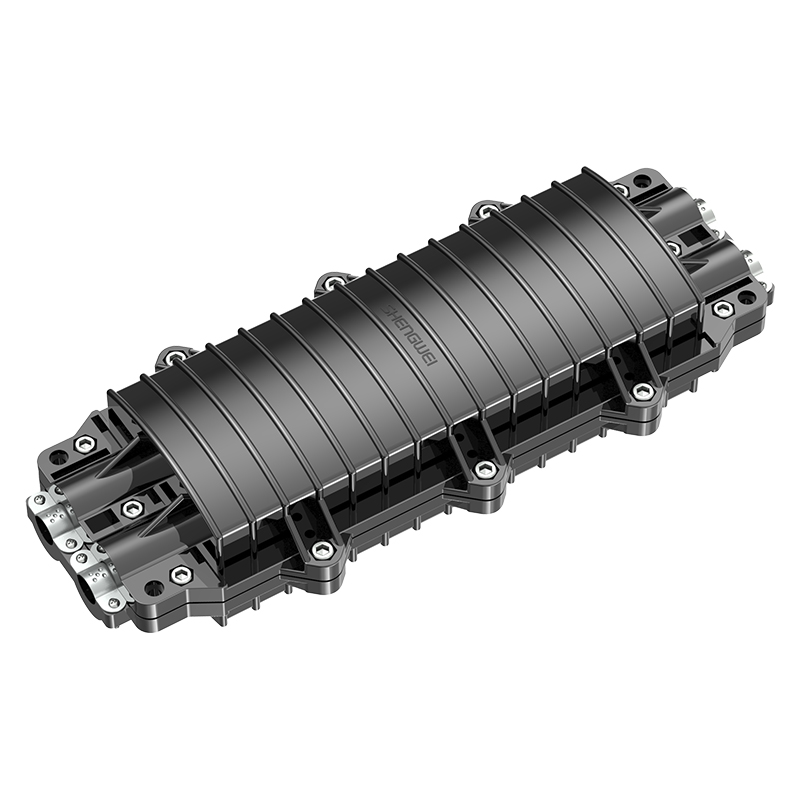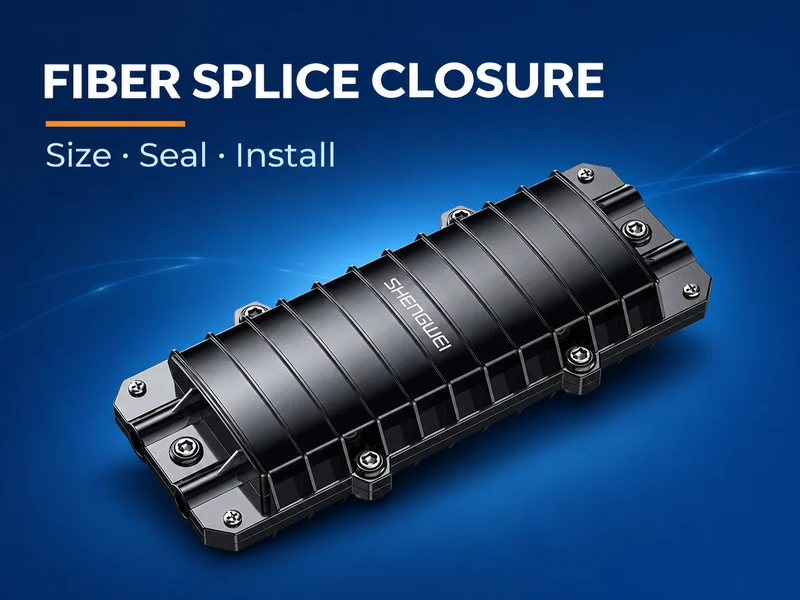
A fusion splice takes about a minute to make, then has to survive 20 years or more in a manhole, on a pole or under a road. The fiber splice closure is what makes that possible. When a closure fails, the cause is usually water ingress, a broken fiber in a crowded tray, or a cable that slipped out of its clamp.
This guide goes beyond “dome or inline”: how to size a closure for today’s cables and tomorrow’s, how to read the datasheet, and which installation mistakes cause repeat site visits.
What a Fiber Splice Closure Does
A fiber splice closure, also called a fiber optic joint closure, is a sealed housing that protects fusion splices where two or more outdoor cables meet. Inside, splices sit in stackable splice trays, buffer tubes are routed and stored, and the cable strength members are clamped to the closure frame so pulling forces never reach the fiber.
Closures sit at straight-through joints, at branch points where a feeder splits into distribution cables, and at mid-span access points where a few fibers leave a continuous cable.
A closure is not an FTTH terminal box. The terminal box is where drop cables connect to subscribers; the closure is a sealed splice point opened only for maintenance or expansion. For terminal boxes, see our guide to fiber optic terminal boxes in FTTH networks.
Dome vs Inline Splice Closures
The two main body shapes suit different routes.
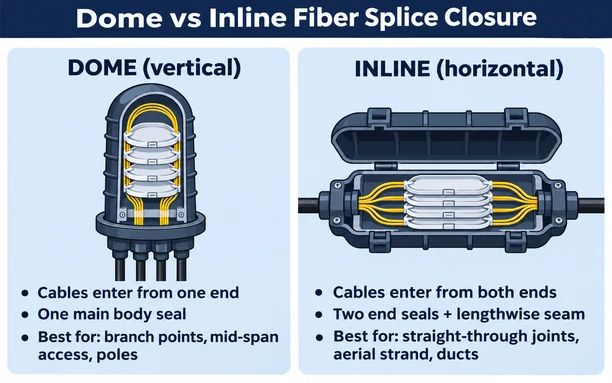
| Feature | Dome (vertical) | Inline (horizontal) |
|---|---|---|
| Cable entry | All cables from one end (base) | Cables from both ends |
| Main sealing points | Dome-to-base seal plus port seals | Two end seals plus a lengthwise seam |
| Fiber management | Spacious; trays hinge for easy access | Longer and narrower; tidy routing takes more care |
| Best for | Branch points, mid-span access, pole and wall mounting | Straight-through joints, aerial strand, narrow ducts and handholes |
| Typical capacity | Small FTTH units to several hundred fibers | Small FTTH units to around 144–288 fibers |
A practical rule: if cables arrive from one direction and branch out, choose a dome. If one cable continues straight on and space is narrow, choose an inline closure. Fewer sealing points also means fewer possible leak paths, which is one reason dome closures are popular in flooded manholes.
How to Choose a Fiber Splice Closure
Work through these four decisions in order.
Count cables and ports first
List every cable entering on day one, then add those planned for the next expansion. Each cable needs its own port, and each port accepts only a set diameter range. An oval port lets an uncut cable loop pass through for mid-span access.
Size splice tray capacity with growth margin
Splice tray capacity is the number most buyers look at first, but it is easy to undersize. Use this method:
- Count the fibers that will actually be spliced, not the total fibers in the cables.
- Divide by the splices per tray (commonly 12 or 24 for single-fiber splicing).
- Add at least one spare tray, or about 25% extra, for repairs and future branches.
- Check that the closure’s maximum tray count covers the result.
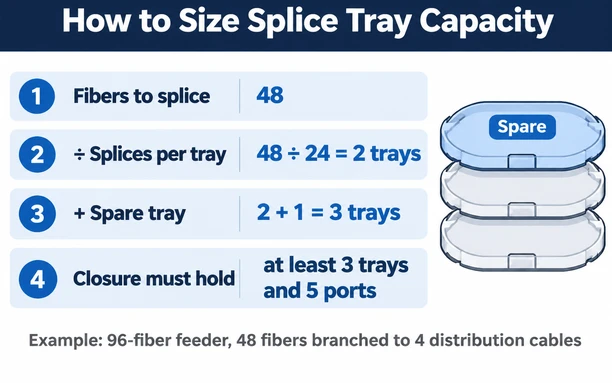
For example, a branch point where a 96-fiber feeder drops 48 fibers into four distribution cables needs 48 splices. With 24-splice trays, that is two trays, plus one spare, so choose a closure that holds at least three trays and has five or more ports.
Choose the sealing system: heat shrink or mechanical
- Heat shrink sealing: uses heat-shrinkable sleeves on the cable ports. It gives a durable seal and suits closures that will rarely be reopened, such as direct-buried backbone joints. The trade-off is that each re-entry needs new sleeves and a torch.
- Mechanical sealing: uses gel, rubber grommets or sealing tape with clamps. It can be reopened and resealed with hand tools, which suits FTTH distribution points where fibers are added over time.
If your crews will return to the closure as subscribers are connected, mechanical sealing usually saves time over the life of the network.
Match the IP rating and mounting to the site
For manholes, handholes or direct burial, IP68 under IEC 60529 is the normal requirement, because the closure may sit underwater for long periods. For aerial and wall mounting, IP65 or higher is often acceptable, but the housing must be UV-stabilized. Mounting brackets and strand hangers are often ordered separately.
Reading a Splice Closure Datasheet
Datasheets look similar from supplier to supplier. These are the lines worth checking:
| Datasheet item | What to check |
|---|---|
| Max fiber capacity | Based on which tray type, and how many trays are included in the price |
| Cable ports | Number, diameter range per port, oval port available or not |
| Sealing method | Heat shrink, gel or mechanical; re-entry without new parts? |
| IP rating | Tested to IEC 60529; IP68 water depth and duration stated |
| Strength member clamp | Fits your cable’s central member (FRP or steel) |
| Grounding | Earthing kit for armored or metallic cables |
| Test standard | Telcordia GR-771 or IEC 60529 test reports available |
If port diameter or the strength member clamp is missing from the datasheet, ask before ordering.
Real-World Example: An FTTH Distribution Point in a Shared Manhole
Consider a regional ISP extending FTTH to a new housing estate. A 96-fiber armored feeder runs through underground ducts, and at a manhole that floods in the rainy season, fibers must branch toward four streets. A sensible specification:
- Closure type: dome, because all cables arrive from below and the operator needs a mid-span cut
- Sealing: mechanical, because the crew will reopen it to add fibers as homes connect
- Protection: IP68, since the closure will be under water for weeks at a time
- Capacity: three 24-splice trays, with one held in reserve
- Grounding: the feeder’s steel armor bonded and grounded through the closure’s earthing kit
For guidance on the feeder itself, see outdoor armored fiber cable for duct and aerial routes.
Installation Mistakes That Let Water In or Break Fibers
Most closure failures come from installation, not the housing. Brief splicing crews on these points:
- Unclamped strength members: temperature changes then push the cable in and out, breaking fibers in the tray.
- Overfilled trays: excess fiber gets pinched when trays are stacked or reopened.
- Tight fiber loops: keep stored fiber above the tray’s minimum bend radius.
- Dirty seals: clean the jacket at each port; one grain of sand can create a leak path.
- Skipped grounding: bond and ground armored cables, or the armor can carry lightning surges.
- No final check: measure splice loss with an OTDR and pressure-test the closure if it has a test valve.
Frequently Asked Questions About Fiber Splice Closures
These are the questions buyers ask most often when specifying a closure.
What is the difference between a dome and an inline splice closure?
A dome closure has all cable ports at one end and suits branch points and pole mounting. An inline closure has ports at both ends and suits straight-through joints, aerial strand and narrow ducts.
Is IP68 required for a fiber splice closure?
IP68 is the normal choice for underground, manhole and direct-buried closures. For aerial or wall-mounted closures, a lower rating such as IP65 may be enough, provided the housing is UV-stabilized.
Can a fiber splice closure be reopened?
Yes, but how easily depends on the sealing. Mechanical and gel seals can be reopened and resealed with hand tools. Heat shrink seals need new sleeves after each re-entry.
How many splice trays do I need?
Divide the number of fibers to be spliced by the splices per tray, then add at least one spare tray for repairs and future branches.
Choosing a Splice Closure That Lasts the Life of the Network
- Pick dome or inline by cable direction and space.
- Size ports and trays for the next expansion, not just day one.
- Choose mechanical sealing where crews will return, heat shrink where they will not.
- Treat clamping, sealing and grounding as part of the specification.
SHENGWEI supplies outdoor fiber splice closures, from compact 12-core joint closures to 144-core horizontal closures [verify]. Browse our fiber splice closure range, or send us your cable types and fiber counts for a matching recommendation.
Need Help Choosing a Fiber Splice Closure?
Tell us your cable types and diameters, the number of fibers to be spliced, and where the closure will be installed (aerial, duct, manhole or direct burial). Our team will recommend a closure size and sealing type for your project.