As AI data centers and 5G-A expand globally, choosing between single mode (SMF) and multimode (MMF) fiber becomes critical. This 2026 guide breaks down key differences to help you future-proof your network infrastructure.
Optical fiber performance hinges on core design, light propagation, and scalability—factors that vary drastically between SMF and MMF, making each suitable for distinct use cases.
Core Differences: SMF vs MMF
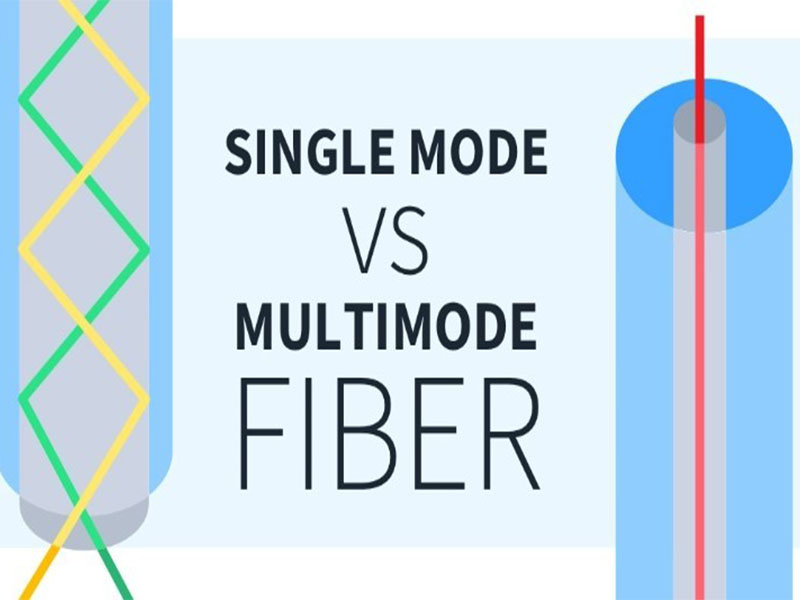
The primary distinction lies in core diameter, which dictates transmission distance and speed. Below is a streamlined comparison of critical specs:
| Key Spec | Single Mode Fiber (SMF) | Multimode Fiber (MMF, OM5) |
| Core/Cladding | 9/125 μm (thin, precision-focused) | 50/125 μm (wider, easy to terminate) |
| Max Distance@100G | 40 km (1550 nm wavelength) | 400 m (via SWDM tech) |
| Light Source | DFB/EML Lasers (high-cost, stable) | VCSEL/LED (low-cost, short-range) |
| Jacket Color | Yellow (TIA-598C standard) | Lime green (OM5) |
Performance & Use Cases (2026 Trends)
Single Mode Fiber: Long-Haul Champion
SMF’s narrow core eliminates modal dispersion, enabling ultra-long transmissions. It’s the backbone of carrier-grade networks, 5G-A backhaul, and cross-border data interconnects. 2026 upgrades like G.654E SMF (ultra-low loss) support 400Gbps over 80 km, ideal for large-scale telecom and DCI (Data Center Interconnect) projects.
Top Use Cases: 5G DCI, FTTH networks, industrial outdoor deployments, and long-distance enterprise connectivity.
Multimode Fiber: Short-Range Cost Saver
MMF’s wider core reduces termination complexity and transceiver costs. OM5 MMF, the 2026 mainstream, handles 400Gbps at 400 m via SWDM tech, making it the go-to for AI data centers. GPU clusters in AWS/Google Cloud rely on OM5 for short interconnects, with upfront costs 30-50% lower than SMF for runs under 500 m.
Top Use Cases: Data center server-to-switch links, enterprise campuses, and retail CCTV systems.
Cost Analysis: Upfront vs Long-Term TCO
MMF has lower upfront costs, but SMF wins for long-term scalability. Transceivers are the biggest cost driver—100G SMF transceivers ($1,800-$2,500) cost 3x more than MMF ($550-$650). For 10-year deployments over 10 km, SMF cuts TCO by 40% by avoiding repeaters ($2,000+ each) and MMF’s frequent upgrades (OM4→OM5→next-gen).
Short runs (<500 m) favor MMF, with labor costs 40% lower due to simpler splicing.
2026 Selection Framework
Choose the right fiber with these three steps:
- Prioritize distance: <500 m = OM5 MMF; >10 km = OS2/G.654E SMF.
- Evaluate budget: Short-term projects benefit from MMF; long-term (5+ years) favor SMF.
- Future-proof: 400G+ needs call for OM5 MMF (short-range) or G.654E SMF (long-haul).
Key FAQ
Q1: Can MMF support high-speed AI workloads?
Yes. OM5 MMF handles 400Gbps at 400 m, perfect for GPU cluster interconnects in data centers.
Q2: Is SMF always more expensive than MMF?
No. For runs >10 km, SMF’s TCO is 40% lower due to no repeaters or frequent upgrades.
Summary
SMF and MMF serve distinct roles in 2026 networks. SMF excels at long-haul, high-speed transmissions for telecom and DCI, while MMF delivers cost-effective short-range connectivity for data centers and campuses. Align fiber type with distance, budget, and scalability to build a network that supports AI, 5G-A, and future digital transformation.