The drop is the shortest cable in an FTTH network, but it causes a large share of service calls. A subscriber’s fiber may run from a pole, across a span, along an outside wall, through a window frame and into a plastic trunking channel, all in less than 100 meters. One FTTH drop cable has to survive every one of those conditions.
Buyers face a second problem: model codes such as GJXFH, GJYXCH and GJYXFCH appear on almost every Chinese datasheet but are rarely explained. This guide decodes them, shows how to choose a drop cable by route, fiber and jacket, and lists the field mistakes that cause repeat truck rolls.
What an FTTH Drop Cable Does
In a PON network, the drop cable is the final link from the terminal box to the ONU inside the home.
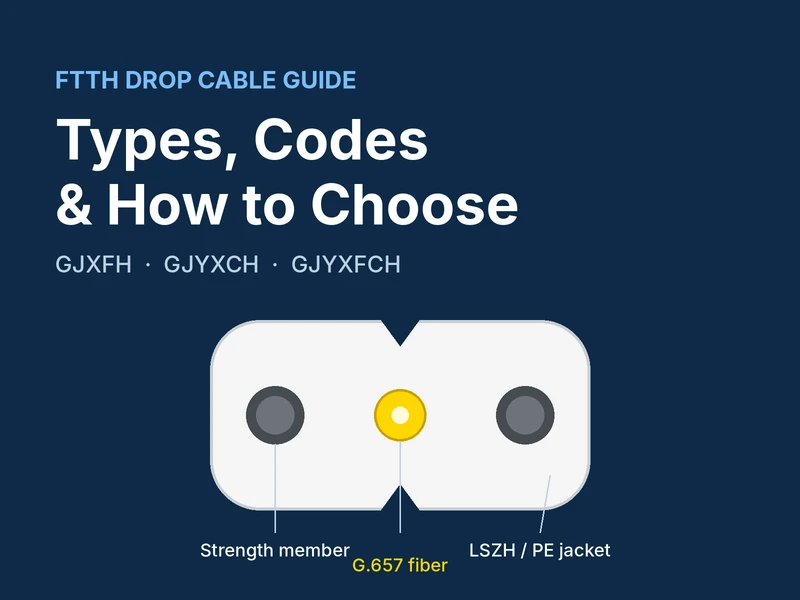
Most drop cables carry 1 to 4 fibers. The most common design is the flat “butterfly” cable: the fiber sits in the center, two parallel strength members sit on each side, and a notch along the jacket lets installers tear it open by hand without special tools.
Decoding Drop Cable Model Codes
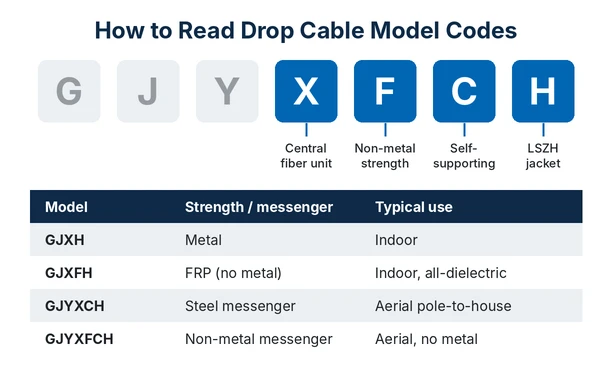
You do not need to memorize the whole Chinese naming system. For drop cables, four letters tell you most of what matters:
| Letter | Meaning | Why it matters |
|---|---|---|
| X | Central fiber unit (butterfly structure) | Standard flat drop design |
| F | Non-metallic strength members (FRP) | No metal: safer near power lines and in lightning-prone areas |
| C | Self-supporting (extra messenger wire) | Can hang across short aerial spans |
| H | LSZH jacket (low smoke, zero halogen) | Required in many indoor installations |
With these four letters, the common models are easy to read:
| Model | Structure | Typical use |
|---|---|---|
| GJXH | Flat drop, metal strength members, LSZH | Indoor routing |
| GJXFH | Flat drop, FRP strength members, LSZH | Indoor routing, all-dielectric |
| GJYXCH | Flat drop + steel messenger wire | Pole-to-house aerial drops |
| GJYXFCH | Flat drop + non-metallic messenger | Aerial drops where metal is not wanted |
A quick rule: if the code has F, there is no metal in the strength members. If it has C, the cable can support itself on a short span. Always confirm with the datasheet, because some suppliers use these codes loosely.
How to Choose an FTTH Drop Cable
Five decisions define the right drop cable for a project: the route, the fiber grade, the strength member, the jacket and the termination method. Work through them in this order, because each choice narrows the next.
Start with the route, not the cable
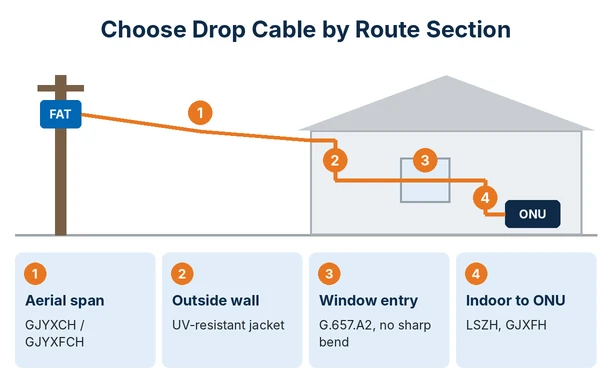
Walk the route, or study photos of it, first. Each section points to a different design:
| Route section | Recommended design | Key check |
|---|---|---|
| Pole to building (aerial) | Self-supporting drop (GJYXCH / GJYXFCH) | Maximum span on datasheet |
| Along outside wall | Outdoor flat drop or self-supporting drop | UV-resistant jacket |
| Underground duct | Round drop or duct-rated flat drop | Crush and tensile rating |
| Inside the home or riser | Indoor flat drop (GJXFH) | LSZH jacket, small bend radius |
| Outside to inside in one run | Indoor/outdoor rated drop | Rated for both environments |
If one cable must run from the pole all the way to the ONU, choose a design rated for both outdoor and indoor use. Forcing an indoor cable outdoors leads to jacket cracking under UV. Running a PE-jacketed outdoor cable indoors can violate building fire rules.
Choose the fiber: G.657.A1 or G.657.A2
Drop cables are installed around door frames, window corners and wall boxes, so bend-insensitive fiber is standard. Both grades are defined in ITU-T G.657 and are compatible with G.652.D fiber in the rest of the network.
- G.657.A1 supports a minimum bend radius of 10 mm. It is suitable for most outdoor drops and routes with gentle bends.
- G.657.A2 supports a minimum bend radius of 7.5 mm. It is the better choice for indoor routing with tight corners, hidden trunking and apartment risers.
For indoor-heavy projects, A2 is the safer default.
Choose the strength member: steel or FRP
Steel wire gives higher tensile strength, but a metallic path can carry lightning surges or induced currents into the home.
FRP (fiber-reinforced plastic) makes the cable all-dielectric. It is preferred in tropical regions with frequent thunderstorms, on poles shared with power lines, and anywhere the operator wants no metal entering the building.
Choose the jacket: LSZH or PE
- LSZH releases little smoke and no halogen gas in a fire. Use it indoors, in risers, and in any building with fire-safety requirements.
- PE resists UV and moisture well and is common for outdoor sections.
Some outdoor drops use UV-stabilized LSZH, which allows the same cable to continue indoors. Check the datasheet for both UV resistance and flame rating.
Bulk cable or pre-connectorized?
Bulk drop cable is cheaper and lets installers cut exact lengths, but it needs a fast connector or fusion splice at each end. For a comparison, see fast connector vs fusion splicing comparison.
Pre-connectorized drops (typically SC/APC) arrive factory-terminated and tested. They cost more but save field time in large rollouts.
Real-World Example: Aerial Drops in a Tropical ISP Network
Consider a regional ISP in Southeast Asia connecting single-family homes from shared utility poles. Spans from pole to house run 30 to 50 meters, and the area has heavy afternoon thunderstorms for much of the year.
A sensible specification for this project would be:
- Pole to wall: GJYXFCH, all-dielectric, so no metal path runs from the pole into the house
- Fiber: G.657.A2, because the same cable continues indoors around window frames
- Jacket: UV-stabilized LSZH, so one continuous cable runs from the terminal box to the ONU
- Hardware: drop clamps sized to the cable’s dimensions at both the pole and the wall
The result: no transition splice and no lightning path into the home.
For apartment buildings in the Middle East or Europe, the picture changes. Drops run from a terminal box in the riser to each unit, so an indoor GJXFH cable with G.657.A2 fiber and an LSZH jacket is usually the right choice. For terminal box selection, see guide to fiber optic terminal boxes in FTTH networks.
Installation Mistakes That Cause Callbacks
Most drop cable failures come from installation, not the cable. Brief crews on these points:
- Using the wrong clamp. A clamp that is too tight crushes the fiber unit. One that is too loose lets the cable slip until the fiber takes the load.
- Stapling flat cable. Staples crush the jacket and add loss. Use cable clips designed for flat drops.
- Sharp bends at entry points. Window frames and door hinges are the most common places for macro-bend loss.
- No drip loop at the wall entry. Without a downward loop, rainwater follows the cable into the building.
- Pulling by the fiber. In ducts, pull by the strength members or a pulling grip, never by the fiber unit.
- Skipping the final test. Measure optical power at the ONU before leaving and fix problems on the same visit.
Frequently Asked Questions About FTTH Drop Cable
What is the difference between GJYXCH and GJYXFCH drop cable?
Both are self-supporting flat drop cables for aerial installation. GJYXCH uses a steel messenger wire. GJYXFCH uses a non-metallic messenger, so the whole cable is dielectric. Choose GJYXFCH near power lines or in lightning-prone areas.
Can I use indoor drop cable outdoors?
Not for permanent installations. Indoor jackets are usually not UV-resistant and can crack after long sun exposure. Use an outdoor-rated or indoor/outdoor-rated drop for any section exposed to weather.
Should I choose G.657.A1 or G.657.A2 fiber for FTTH drops?
G.657.A1 works for most outdoor routes. Choose G.657.A2 when the cable runs indoors through tight corners, hidden trunking or risers, because it tolerates a smaller bend radius.
How many fibers should a drop cable have?
One fiber is enough for a single PON subscriber. Many operators choose 2-fiber drops so a spare fiber is available if the first one is damaged, at only a small cost increase.
Build Reliable Drops from the Route Inward
- Choose the FTTH drop cable by route first.
- In model codes, F = non-metallic, C = self-supporting, H = LSZH.
- Use G.657.A2 indoors and all-dielectric designs where lightning is a risk.
- Installation quality matters as much as the cable.
Explore SHENGWEI’s FTTH drop cable range for indoor, outdoor and self-supporting options, or contact us for datasheets and project pricing.
Need Help Choosing the Right FTTH Drop Cable?
Share your route type (aerial, wall, duct or indoor), span length, fiber count, preferred fiber grade and quantity with SHENGWEI. The team can recommend suitable drop cable designs and send datasheets for evaluation.