As AI data centers and 5G-A expand globally, choosing between single mode (SMF) and multimode (MMF) fiber becomes critical. This 2026 guide breaks down key differences to help you future-proof your network infrastructure.
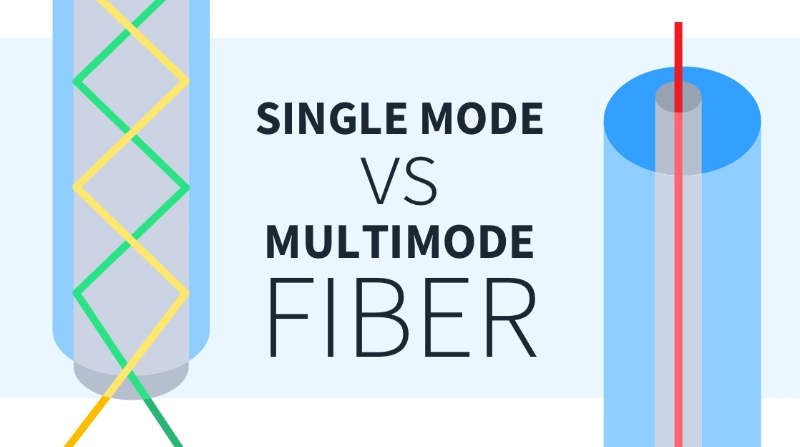
Optical fiber performance hinges on core design, light propagation, and scalability—factors that vary drastically between SMF and MMF, making each suitable for distinct use cases.Core
Differences: SMF vs MMF
The primary distinction lies in core diameter, which dictates transmission distance and speed. Below is a streamlined comparison of critical specs:
| Key Spec | Single Mode Fiber (SMF) | Multimode Fiber (MMF, OM5) |
| Core/Cladding | 9/125 μm (thin, precision-focused) | 50/125 μm (wider, easy to terminate) |
| Max Distance@100G | 40 km (1550 nm wavelength) | 400 m (via SWDM tech) |
| Light Source | DFB/EML Lasers (high-cost, stable) | VCSEL/LED (low-cost, short-range) |
| Jacket Color | Yellow (TIA-598C standard) | Lime green (OM5) |
Performance & Use Cases (2026 Trends)
Single Mode Fiber: Long-Haul Champion
SMF’s narrow core eliminates modal dispersion, enabling ultra-long transmissions. It’s the backbone of carrier-grade networks, 5G-A backhaul, and cross-border data interconnects. 2026 upgrades like G.654E SMF (ultra-low loss) support 400Gbps over 80 km, ideal for large-scale telecom and DCI (Data Center Interconnect) projects.
Top Use Cases: 5G DCI, FTTH networks, industrial outdoor deployments, and long-distance enterprise connectivity.
Multimode Fiber: Short-Range Cost Saver
MMF’s wider core reduces termination complexity and transceiver costs. OM5 MMF, the 2026 mainstream, handles 400Gbps at 400 m via SWDM tech, making it the go-to for AI data centers. GPU clusters in AWS/Google Cloud rely on OM5 for short interconnects, with upfront costs 30-50% lower than SMF for runs under 500 m.
Top Use Cases: Data center server-to-switch links, enterprise campuses, and retail CCTV systems.
Cost Analysis: Upfront vs Long-Term TCO
MMF has lower upfront costs, but SMF wins for long-term scalability. Transceivers are the biggest cost driver—100G SMF transceivers ($1,800-$2,500) cost 3x more than MMF ($550-$650). For 10-year deployments over 10 km, SMF cuts TCO by 40% by avoiding repeaters ($2,000+ each) and MMF’s frequent upgrades (OM4→OM5→next-gen).
Short runs (<500 m) favor MMF, with labor costs 40% lower due to simpler splicing.
2026 Selection Framework
Choose the right fiber with these three steps:
- Prioritize distance: <500 m = OM5 MMF; >10 km = OS2/G.654E SMF.
- Evaluate budget: Short-term projects benefit from MMF; long-term (5+ years) favor SMF.
- Future-proof: 400G+ needs call for OM5 MMF (short-range) or G.654E SMF (long-haul).
Key FAQ
Q1: Can MMF support high-speed AI workloads?
Yes. OM5 MMF handles 400Gbps at 400 m, perfect for GPU cluster interconnects in data centers.
Q2: Is SMF always more expensive than MMF?
No. For runs >10 km, SMF’s TCO is 40% lower due to no repeaters or frequent upgrades.
Summary
SMF and MMF serve distinct roles in 2026 networks. SMF excels at long-haul, high-speed transmissions for telecom and DCI, while MMF delivers cost-effective short-range connectivity for data centers and campuses. Align fiber type with distance, budget, and scalability to build a network that supports AI, 5G-A, and future digital transformation.